What to see in Orvieto in a day
Orvieto sits impossibly atop a 150-meter volcanic tuff cliff that rises sheer from the Umbrian plains. You see it from kilometers away - the entire medieval city perched on this isolated plug of volcanic rock, with the golden mosaics of the Gothic cathedral catching light at the summit. The cliff is the reason Orvieto exists, and understanding the cliff explains everything else: why the Etruscans chose this spot 2,500 years ago, why they carved over 1,200 caves into the soft volcanic tuff beneath the city, why popes fled here during political chaos, and why the cathedral facade is among the most spectacular in the world.
The city you see today is complete medieval - the historic center forced by the cliff's perimeter into an unusually preserved 13th-century street pattern. Modern development stayed in the valley below while the old city remained spatially constrained. This geographical accident created one of Italy's most coherent medieval urban experiences. The cliff's isolation that once provided defensive advantage now offers visitors something rarer: a whole medieval city that actually feels medieval.
You come to Orvieto for two things that work together: the spiritual magnificence of the cathedral (Luca Signorelli's frescoes of the Last Judgment painted before Michelangelo's Sistine Chapel version, and Michelangelo studied them), and the pragmatic ingenuity of the underground city carved from the volcanic tuff over 2,500 years. Cathedral pinnacle to subterranean depths - both are essential.
Getting there and parking
Whether arriving by train or car, start at Orvieto Scalo railway station at the cliff base. Free parking available here.
Orvieto's Cable Car
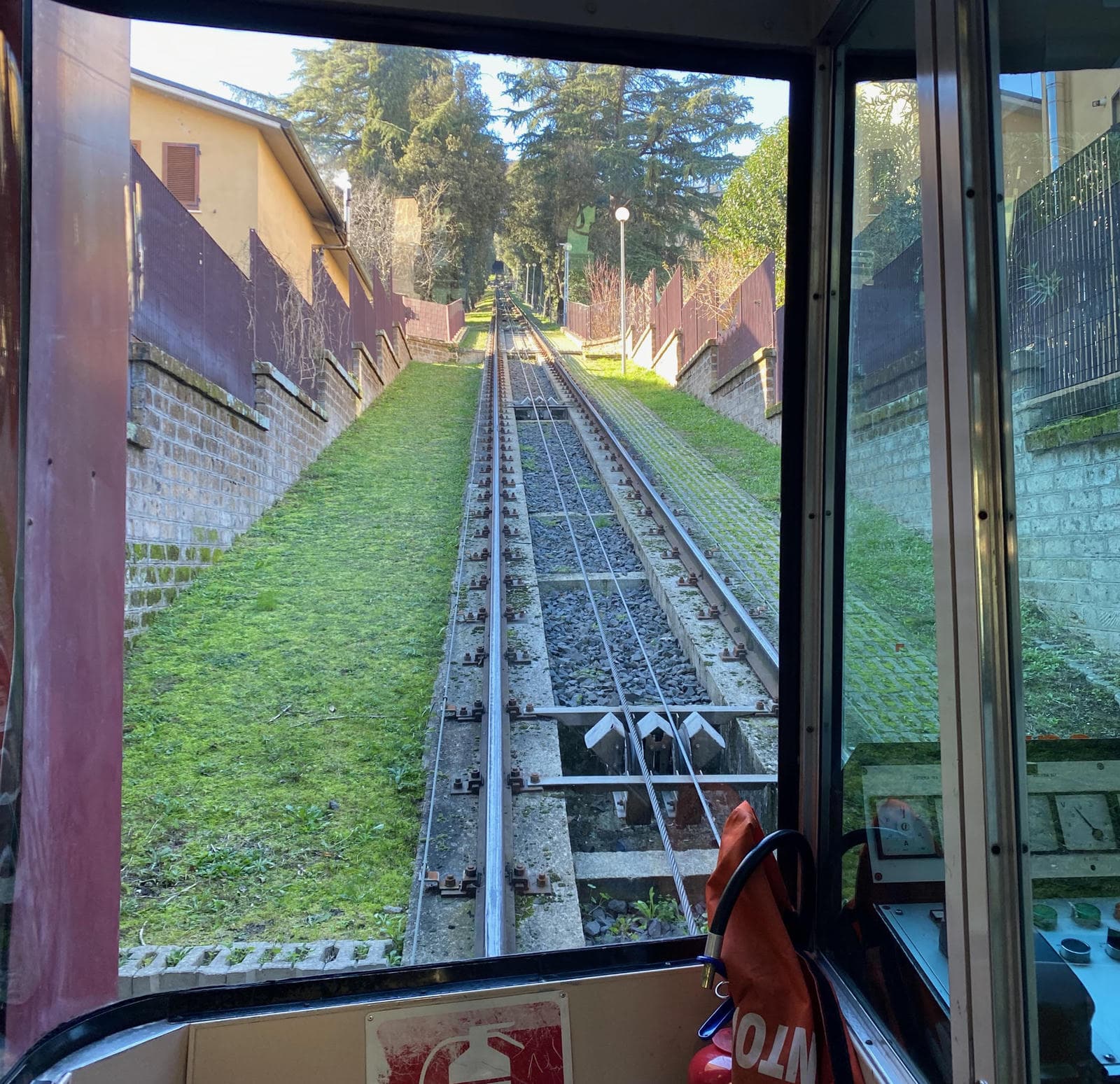
Whether you reach Orvieto by train or by car, it is best to start your visit from the Railway Station at the bottom of Orvieto's steep hill. You can park here for free if you come by car and then walk to the city's little telepherique which will carry up to the city itself in a charming and vintage carriage.
The ride costs 5 euro, takes 5 minutes and will bring you onto the city's plateau, from where you can easily walk around the city, or take a taxi if you prefer. The vintage carriages date from 1888 (rebuilt 1991), and the ride itself is part of the experience - you're ascending the cliff face the Etruscans chose for defense.
From Piazza Cahen, Bus A runs to Piazza del Duomo (€1.30), or walk 10 minutes through medieval streets.
Time Needed
Minimum half-day (4-5 hours): Cathedral including Chapel of San Brizio (90 minutes), Underground Orvieto tour (60 minutes), basic historic center walk.
Full day: Add Museo Claudio Faina (Etruscan artifacts), lunch at a traditional trattoria, secondary churches, cliff-edge walk (Anello della Rupe), browse ceramics workshops and wine shops.
Overnight: Early morning and evening when day-trippers leave reveal Orvieto's quieter character.
Tickets for Orvieto's attractions
Buy the Orvieto Carta Unica (€25 for 5 attractions over 365 days): Cathedral including Chapel of San Brizio, Orvieto Underground tour, Torre del Moro, Museo Claudio Faina, Pozzo di San Patrizio. You can buy one online here: Orvieto Carta Unica, or at the tourist office in Piazza del Duomo
1. Visit il Pozzo di San Patrizio (St. Patrick's Well)
Pope Clement VII commissioned this engineering marvel in 1527 (designed by Antonio da Sangallo the Younger) after fleeing Rome during the Sack of Rome. He needed guaranteed water supply in case of siege. The solution: a 62-meter-deep well with a double-helix staircase - two spiral staircases wound around the well shaft, one for descent, one for ascent, so water-bearing donkeys could operate continuously without meeting. 248 steps down, 248 steps up (if you walk both spirals), with 70 windows illuminating the descent.
The name references the legend that St. Patrick's Purgatory in Ireland was a deep cave offering entrance to Purgatory if you reached the bottom - the depth and darkness of Orvieto's well earned the comparison.
Entry €5 (included in Carta Unica). Located in Piazza Cahen where the funicular arrives - visit first before walking into town, or save for the end. Allow 30 minutes including both staircases (or 15 minutes if you descend one and skip the other).
2. Duomo di Orvieto
The facade alone justifies the trip - golden mosaics glowing against black-and-white striped marble, intricate bas-reliefs carved by Lorenzo Maitani depicting biblical scenes from Genesis to the Last Judgment.
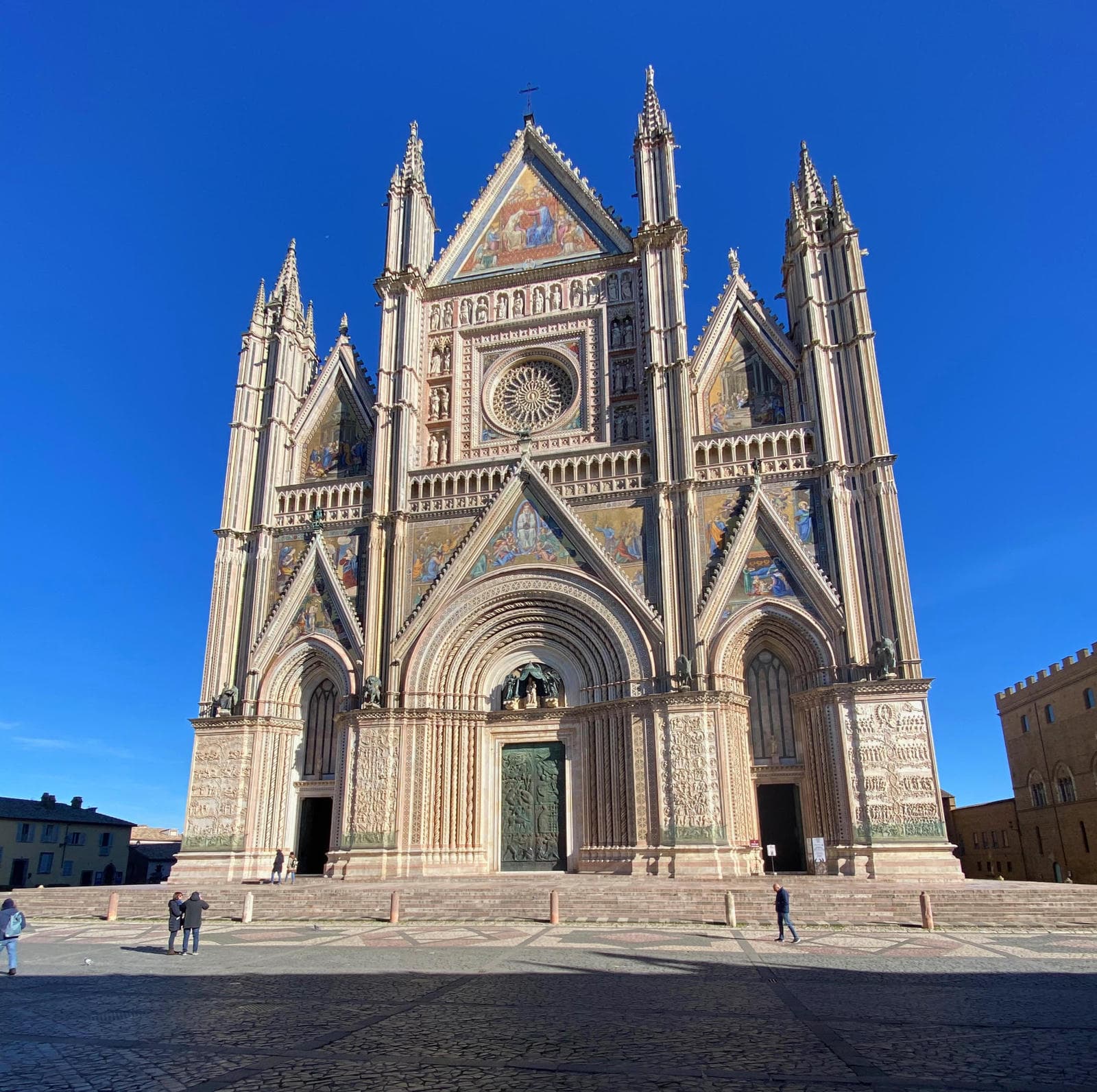
Work on the Cathedral was started in 1290, reputedly by Arnolfo di Cambio, the very same fellow who built the base of the Duomo in Florence, then leaving the problem of the enormous dome needed to cover it to a later generation and the genius of Brunelleschi.
Several other architects (for want of a better word for this designer-craftsmen of the middle ages) were charged with carrying on the work on Orvieto's Cathedral. Lorenzo Maitani from Siena is responsible for much of the Cathedral's appearance today though the work was unfinished when he died in 1330. After this date a series of sculptors were charged with different parts of the facade which may well account for its intricate and interesting appearance - one can find endless humour in the faces and scenes depicted in the carved stone facade.
If you haven't bought a Carta Unica, you will need a ticket to visit the Cathedral, you can buy them in Piazza Duomo nº 25, opposite the Cathedral itself.
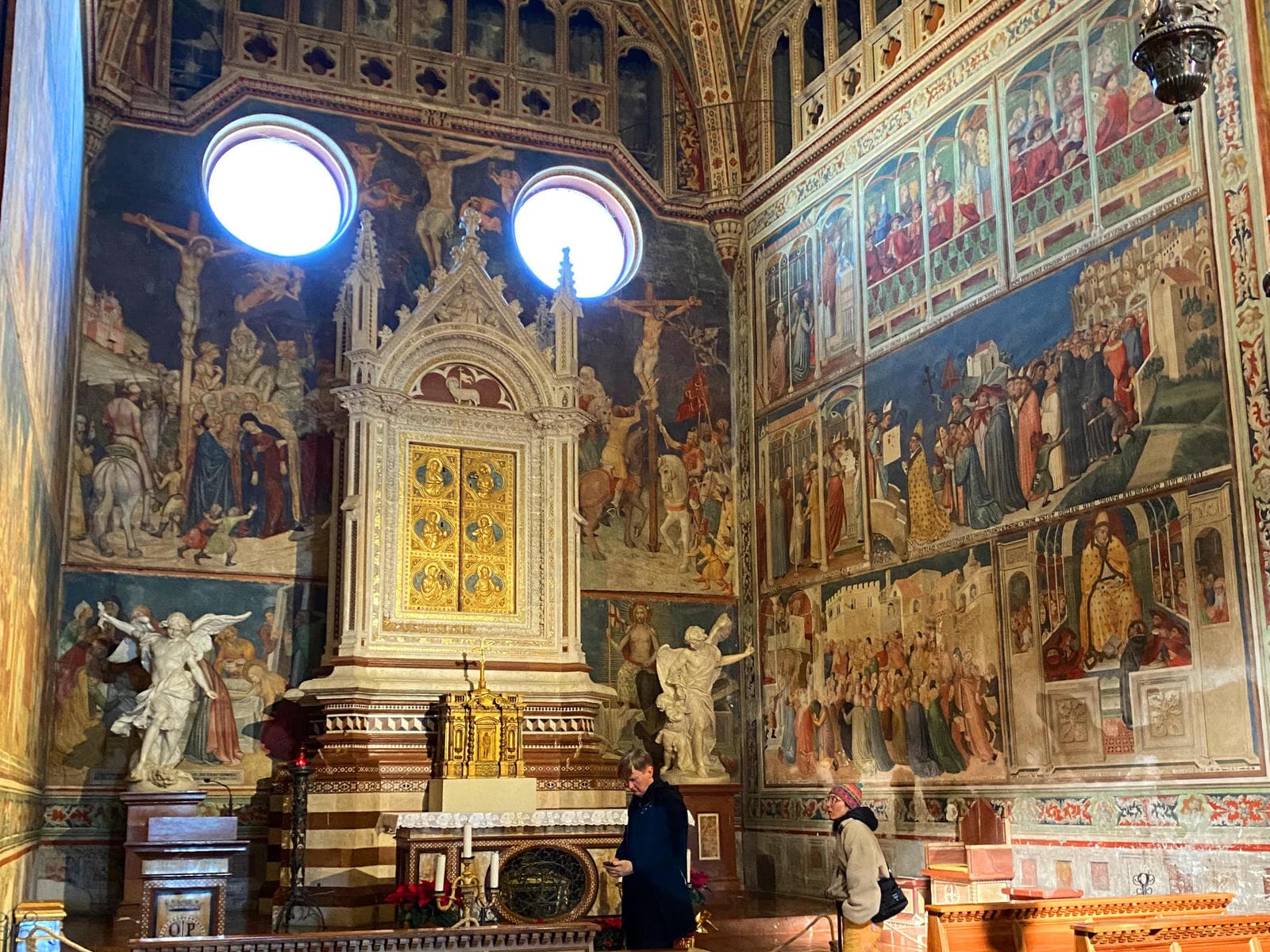
Make sure you see two chapels in the church, Cappella di San Brizio and Cappella del Corporale.
Cappella di San Brizio (Chapel of San Brizio): Luca Signorelli's frescoes of the Last Judgment (1499-1504) are staggering. Michelangelo studied these before painting the Sistine Chapel ceiling - the musculature, the drama, the composition. Signorelli started what Beato Angelico had begun decades earlier, creating one of the Renaissance's greatest artistic achievements. The lower section showing the resurrection of the dead, the damned being dragged to hell, the blessed ascending to paradise - this is where Renaissance painting became fully three-dimensional.
Cappella del Corporale: Houses the relic of the Corporal of Bolsena - a cloth said to bear stains from a 13th-century Eucharistic miracle when consecrated bread began bleeding during Mass in nearby Bolsena. Pope Urban IV (resident in Orvieto at the time) instituted the Feast of Corpus Christi in response. The relic sits in a specially designed reliquary, surrounded by frescoes depicting the miracle's story.
3. Stroll to Piazza della Repubblica
After your underground explorations, wander through the charming streets of Orvieto's historic center, taking in the picturesque architecture and lively atmosphere. You'll pass a number of places you might like to stop at along your way:
Torre del Maurizio
As you leave Piazza del Duomo, have a look at Torre del Maurizio, an interesting church tower, built between 1347 and 1348 to mark the daily work shifts of the cathedral workers. Today it is the oldest time-keeping automaton still existing and functioning today, a self-propelled work of extraordinary effect. The bronze automaton statue is connected to the chronometer below, at the stroke of every hour it strikes the bell with an iron hammer.
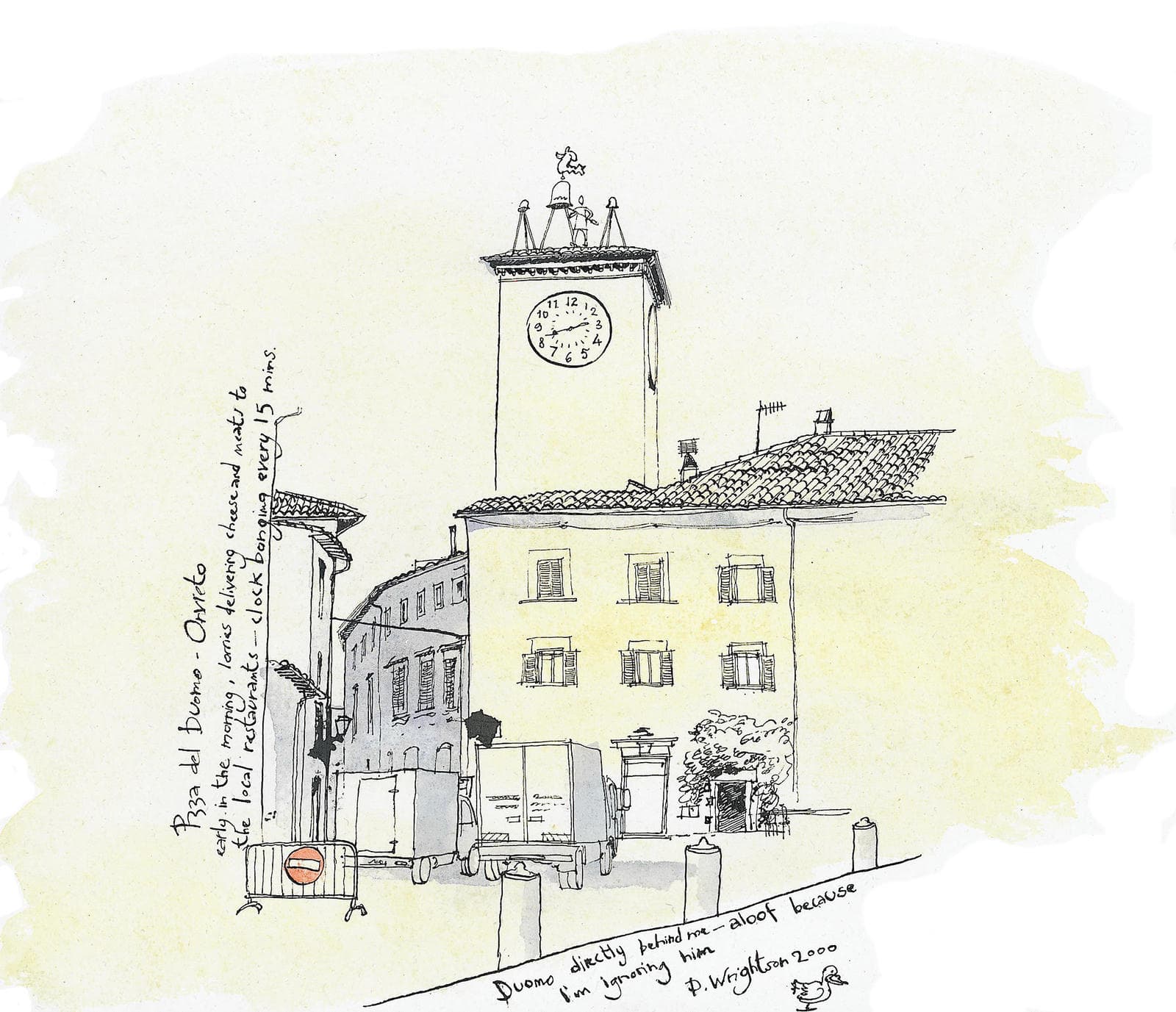
Impossible to see from the ground, an amusing exchange of words is engraved on the automaton and the bell. One, along the belt worn by the automaton, reads: "Da te a me, campana, furo i pati: tu per gridar et io per far i fati" which roughly translates as: From you to me, bell, was the agreement: for you to shout and I to do the deed; the other on the crown of the bell, warns him in response: "Se vuoi ch'attenga i pati, dammi piano. Se no io cassirò e darà invano" or If you want me to deliver what was agreed, strike me gently. Otherwise I will break and your work will be in vain.
Torre del Moro
This striking tower is at the heart of the city, on the crossroads between Corso Cavour, and Via del Duomo. Unlike the Torre del Maurizio which is rarely open to the public, this tower can be climbed to a spectacular terrace with beautiful views of the city and the surrounding landscape.
Next to the tower is the beautiful Palazzo dei Sette, named in medieval times because it housed the seven judges who represented the major corporations and trades of Orvieto.
By now it's probably time for lunch, so why not stop at a local restaurant?
Trattoria la Palomba, in Via Cipriano Manente, 16, a charming and typical Trattoria named after the 'Palomba', another name for dove, often eaten when the city was under siege. Today you'll find classic pasta dishes, including one with wild boar sauce which is delicious.
or in Giovanni's garden restaurant in Via di Piazza del Popolo, 9. Ristorante il Giardino da Giovanni has plenty of truffle based dishes and other local specialities.
4. Explore underground Orvieto - La Città Sotterranea
Beneath your feet lies another Orvieto - over 1,200 hand-carved caves, tunnels, and chambers carved over 2,500 years from the soft volcanic tuff. The Etruscans started this in the 6th century BC; every generation since added their own excavations. What began as defensive cisterns became medieval olive presses, wine cellars, pigeon farms for food, Renaissance escape routes, and eventually WWII bomb shelters.
The 60-minute guided tour (departing from Piazza del Duomo 23) takes you through a selected section revealing this underground city's layers. You'll see Etruscan cisterns using the "frame" technique from the 5th century BC, a 30-meter Etruscan water tunnel still open and visitable, medieval pigeon-farming rooms (dovecotes with individual niches carved for nesting pairs - pigeons were essential protein during sieges), a medieval olive press that produced oil for the entire city (the large basalt millstones and reconstructed wooden press are still visible), ceramic kilns from the 18th century (different ceramic vases found in wells established Orvieto's pottery tradition), and chambers converted to air-raid shelters in 1943.
Tours run daily at 11am, 12:15pm, 4pm, 5:15pm. Book ahead in peak season: Website: orvietounderground.it or buy tickets at the tourist office.
Alternative: Pozzo della Cava (different entrance, Via della Cava 28) offers a self-guided route through a privately-owned section including a 36-meter-deep Etruscan well. More intimate, less structured than the official Underground tour.
You can also visit Adrian's Labyrinth, a network of caves discovered by the owners of the restaurant above, and gradually explored and then opened to the public. The eponymous restaurant is in Via della Pace, 26.
Website: labirintodiadriano.com
Best villa near Orvieto, Umbria
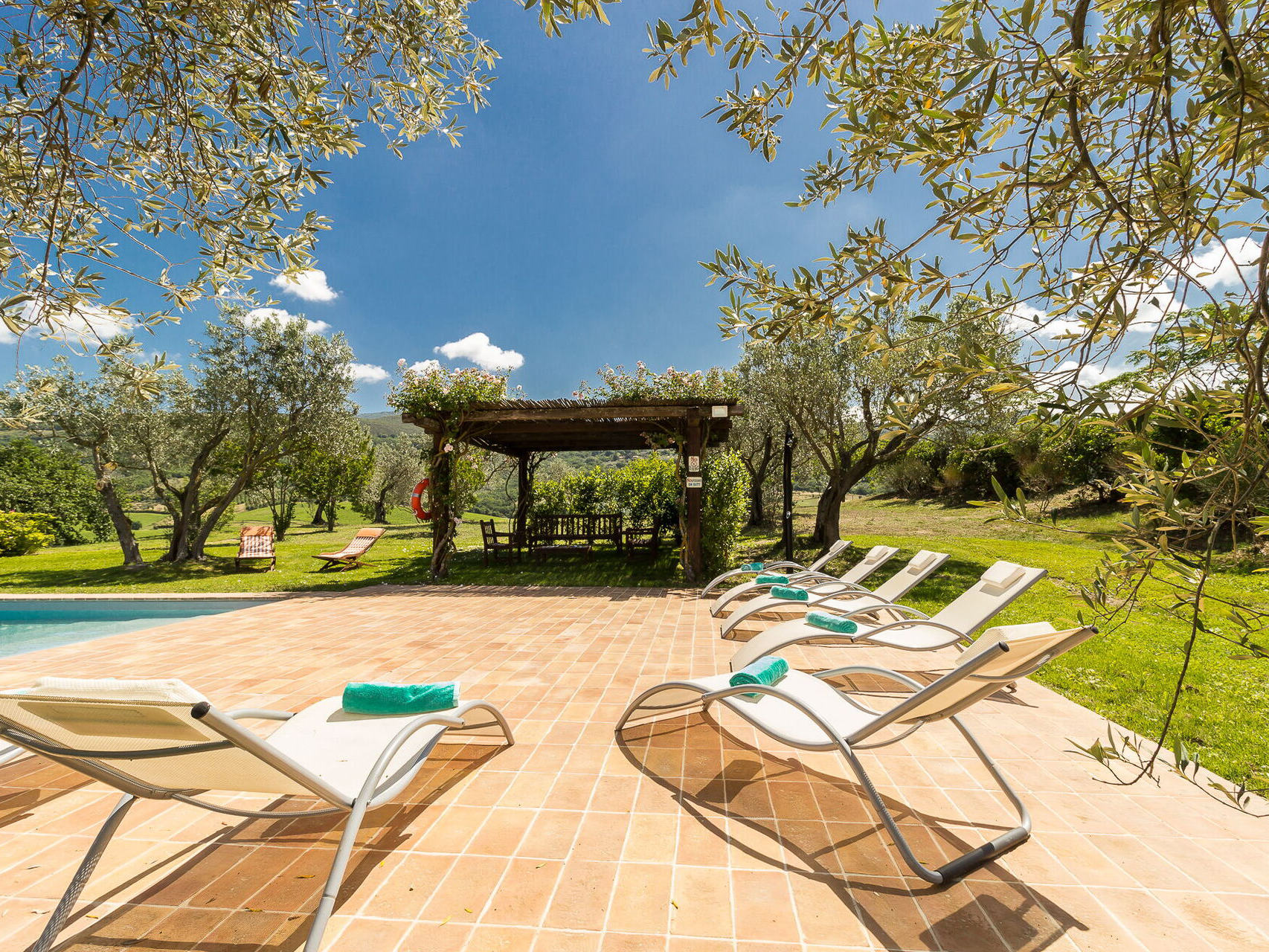
The best way to explore Orvieto and the nearby area is to stay in a villa in the area. Villa Silenti is a beautiful villa for 14 just a short drive away, in the Tiber valley.
Villa Silenti for 14
Located halfway between Orvieto and Todi, Silenti presents views that encompass the Castle of Guardea and the vast rolling countryside. Its strategic location serves as an excellent starting point for exploring the southern regions of Tuscany, Umbria, and Lazio.
Author: Dan Wrightson
Dan Wrightson grew up in Tuscany, Italy and has been writing about, sketching and exploring Tuscany and Italy since 1983.
19th Apr 2024 15th Apr 2026