Location and landscape
Lucignano is a beautiful walled village in southern Tuscany, on a hill south of Florence and Arezzo, west of Cortona and east of the Val d'Orcia. The position is strategic and has been so for centuries, with the neighbouring powers of Arezzo, Siena, Florence and Perugia fighting for control of this tiny fortified village and its surrounding territory.
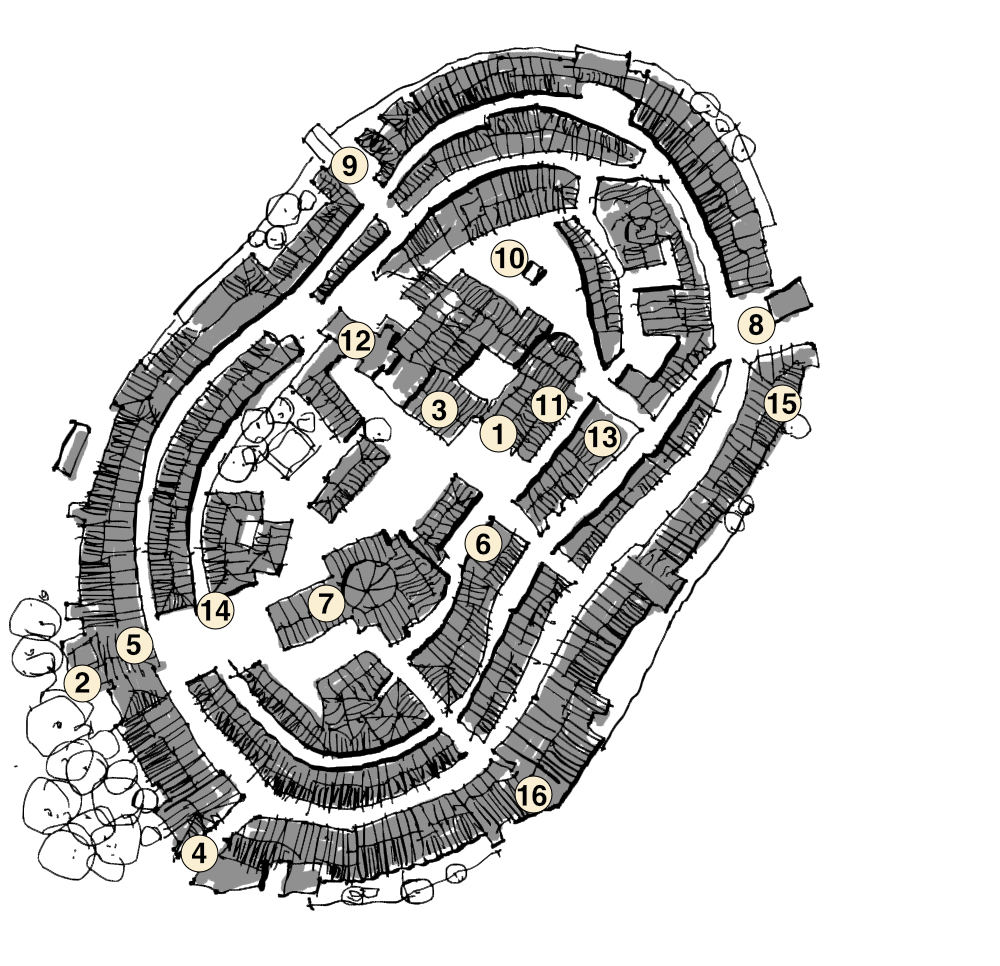
Elliptical street plan
The result has been a village designed entirely around defensive principles, with the streets folded into a series of elliptical rings, each successively surrounding the heart of the village where the Palazzo Pretorio and the Collegiata sit. The concentric rings form defensive bottlenecks, easy to defend and daunting to head into as an attacker, with escape routes shrinking as any invaders progress. Today there are no invaders, but the wonderful Mandala-like town layout remains.
- Church and convent of San Francesco
- Cassero - Florentine fortress
- Palazzo Pretorio (Town Hall) and Museo Civico
- Porta San Giusto
- Cinema and Theatre
- Church of San Giuseppe
- Collegiata of San Michele Arcangelo
- Porta San Giovanni
- Porta Murata
- Torre delle Monache
- Oratory of Corpus Domini
- Church of crocifisso
- Church of the Misericordia
- Piazza delle Logge
- Torreone Picconi
- Porta Sant'Angelo
Piazza del Tribunale
The heart of Lucignano is Piazza del Tribunale. On one side sits the Palazzo Pretorio (13th century), the town hall, which now houses the Civic Museum on its ground floor. The Collegiata di San Michele Arcangelo rises on another side, its facade visible from most approaches. Small cafés and restaurants edge the piazza. It's the natural gathering point – where locals sit with coffee in the morning, where families converge in the evening.
Lucignano is still very much a living town and has a functioning butcher, a proper grocer, a bar where locals gather for espresso. The pasticceria sells panettone at Christmas and local pastries year-round. You can buy lunch supplies and eat in the piazza.
History of Lucignano
Humans have been living here for millennia, and there are Etruscan traces around Lucignano, with several Etruscan tombs providing rich findings, including a statue now housed in the British Museum in London. Romans followed the Etruscans and the name of the village is probably derived from a Roman family, the Licini, that had large tracts of farming land here. Both Pliny and Strabo mention Lucignano, praising the quality of the olive oil from the area.
But the Lucignano we see today was built through several turbulent centuries in the middle ages, when the village was hotly contended by the local powers of Siena, Arezzo, Florence and Perugia. Each left an improvement in the fortifications until by the end of the fourteenth century the town and its concentric walls were complete. The town continued to be strategically important until the end of the 16th century when the unification of Tuscany into one political entity made Lucignano's importance decline, and the village became a quiet agricultural backwater, keeping its medieval layout and character safe for us to enjoy today.
What to see in Lucignano
For a small town Lucignano packs quite a punch. Here's a description of the town's defensive gates and of some interesting buildings wirth visiting.
The Gates & Streets
Porta San Giusto opens on the southwest side of the walls facing Siena, the main entrance to the historic center. The rectangular gate carries a copy of the Medici coat of arms (the original fell in 1965). Turning right from the gate, you enter Via Matteotti, the principal street, formerly called Via dell'Amore (for its connection to Siena) or Borgo Ricco because powerful families built palaces here: Palazzo Battelli-Renzuoli, Palazzo Arrighi-Griffoli (now an elderly care center), and Palazzo Arnaldi-Capei (the only one retaining intact medieval character).
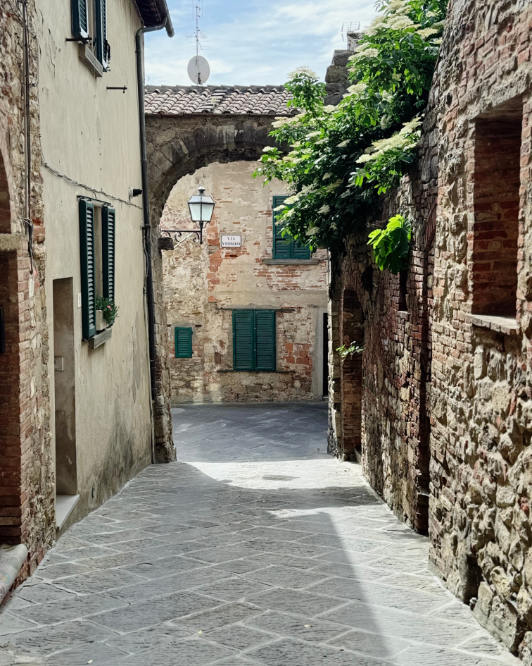
Porta S. Angelo opens between these palaces – closed in the late 18th century during the Viva Maria riots, it's now a sealed passage within the walls. Further along sits the Hospital of S. Anna (founded 1397, active until the 20th century).
Porta S. Giovanni (or Porta al Filaio) has a pentagonal plan. Via Roma continues the circuit – historically called "via Povera" (poor street) where working-class residents lived among artisan workshops and modest shops. Along it runs the ancient Orto dei Frati (Friars' Garden), used for centuries by locals for daily cultivation.
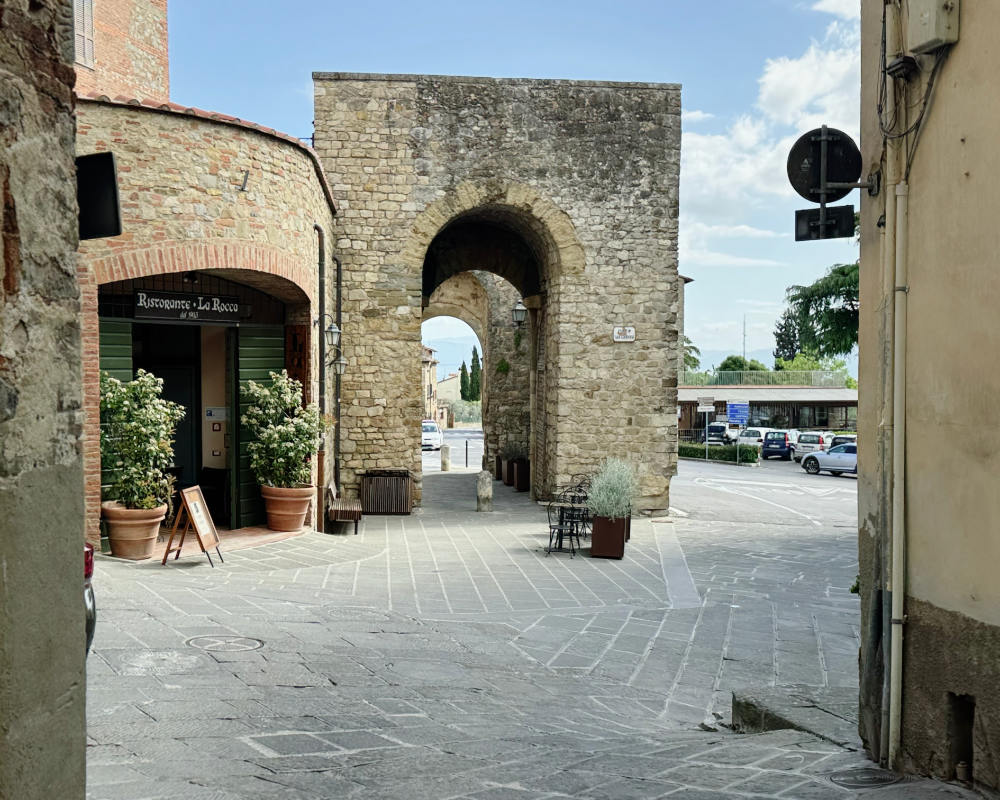
Porta Murata was sealed in the 16th century during the Siena war and only reopened after restoration in the late 20th century. Medieval stone paving (in serena and limestone) remains visible in the gate's interior passage.
A stone on the steps of San Giuseppe above Via Matteotti is inscribed "Libertà di suono e canto" (Freedom of sound and song). Tradition holds this marks the symbolic boundary between the upper town – seat of religious and political power, governed by monastic silence – and the lower town, the civil heart and everyday life of common people.
The Cassero
The Cassero was built in the 14th century by Sienese craftsmen as a military fortress. After Siena's defeat in 1554, it lost its defensive role and was converted to grain storage, then in 1829 became a small theater.
Two coats of arms remain visible on the interior facade: Siena's balzana (bicolour emblem) and the rampant lion symbolizing medieval Sienese power over Lucignano.
Piazza della Logge
Directly in front sits Piazza delle Logge, built after 1558 under Cosimo I de' Medici to reorganize the town following the Medici victory. The logge reference the three authorities of the time: religious, civil, and military.
Today it's part of the Civic Museum and hosts temporary exhibitions and cultural events. The upper logge has a panoramic terrace overlooking the Val di Chiana, connecting the town's oldest core (at higher elevation) with the later development within the last ring of walls.
Collegiata di San Michele Arcangelo
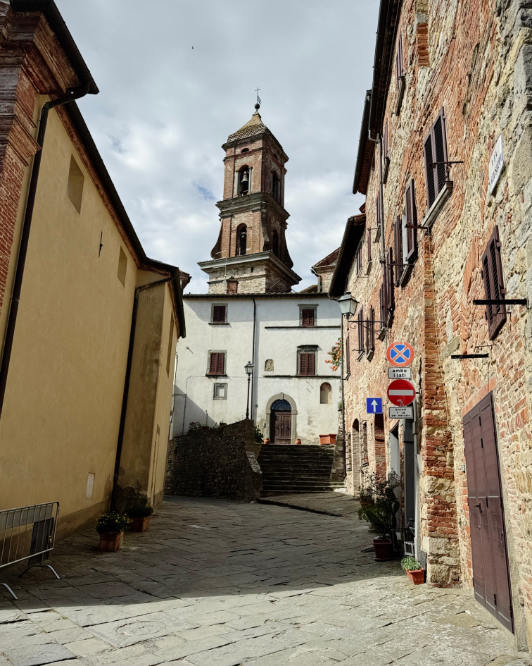
The church stands at the south end of Piazza del Tribunale, where a fortress (possibly Lombard) once stood until destroyed by lightning in May 1556. A small church dedicated to San Michele occupied the site. After the fortress was dismantled, the community built a larger church to accommodate the full population. The external travertine staircase – elliptical in form to echo the town's urban planning – was designed in 1712 by Andrea Pozzo, a Trentine Jesuit architect and painter. The facade (completed lower half only) is brick with four stone pilasters; the stone portal dates to 1715. Inside, there are some important 17th-century paintings, including works by Matteo Rosselli, Onorio Marinari, Giacinto Gemignani, and others. The Chapel of the Holy Sacrament contains a 14th-century wooden Miraculous Crucifix from the now-ruined church of Santa Margherita.
Church of San Francesco
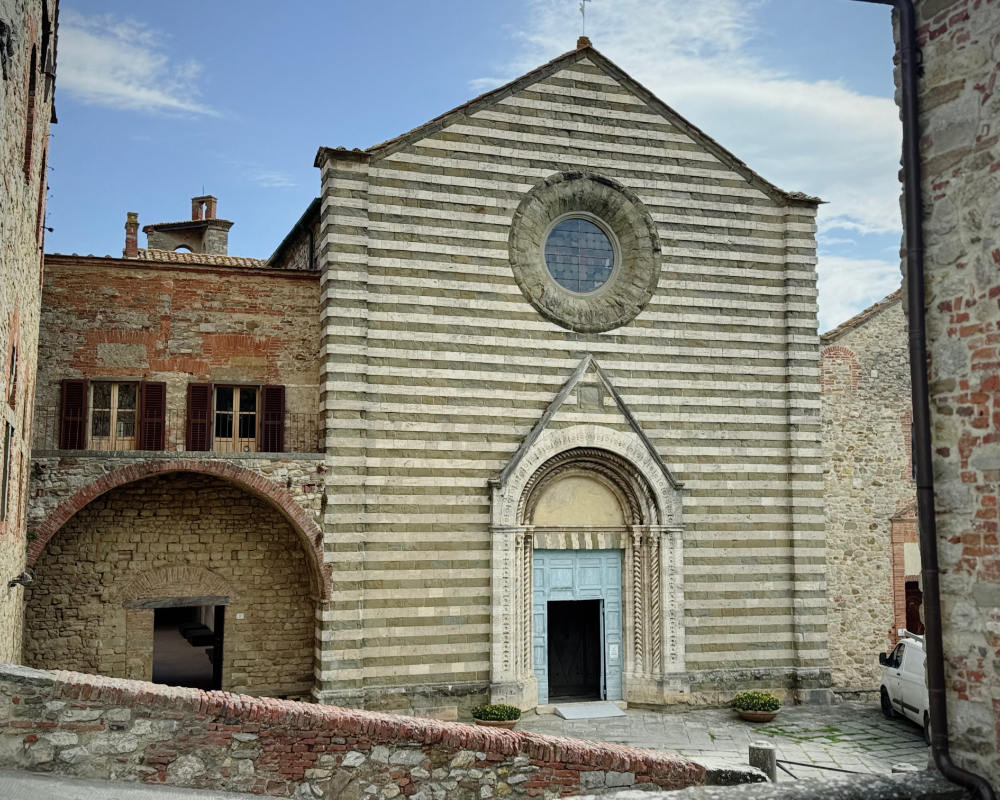
Built between in the middle of the thirteenth-century, San Francesco's facade is stripy, with bands of sandstone and travertine and a refined portal and stone rose window. Inside, the high altar holds a 14th-century polyptych by Luca di Tommè showing the Madonna and Child with saints John the Baptist, Michael Archangel (holding the castle of Lucignano), Peter, and Catherine of Alexandria. Some original frescoes remain, attributed to Bartolo di Fredi and Taddeo di Bartolo, though many were lost or covered by 17th-century altars. The right transept displays scenes from the life of Saint Francis and the Visitation of the Magi. Notable is the "Triumph of Death" fresco – a common 14th-century theme following plague epidemics – showing Death on horseback striking down young hunters while ignoring the elderly who welcome it. Above, an inscribed Christ warns the viewer of human destiny.
The Cloister of San Francesco
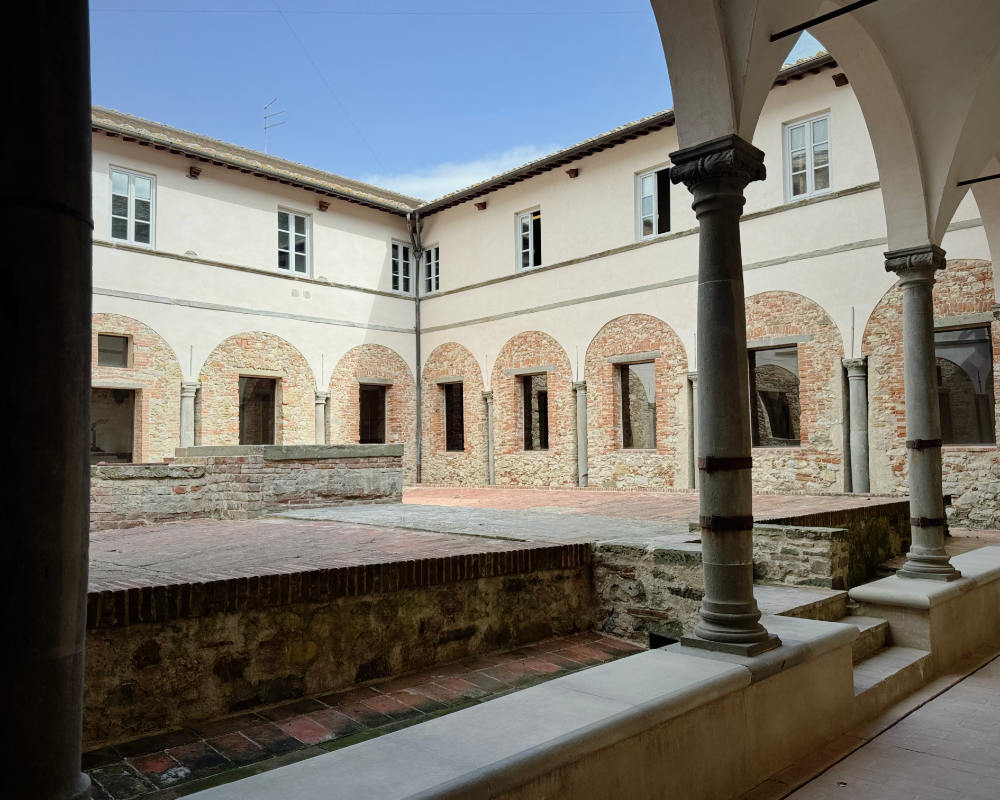
The Franciscan cloister dates to the 13th century when the order established itself in Lucignano. The quadrangular plan reflects Franciscan simplicity: arcaded galleries with stone columns surrounding a central courtyard that once held a small garden. The cloister connected to the main convent spaces – church, common rooms, dormitories, study and prayer areas. The 15th-century cloister was closed in the 19th century to accommodate a weaving school (active until the 1960s). Frescoes by Antonio Taddei that decorated the spaces are now badly compromised. Sadly the complex is not currently open to visitors.
Civic Museum & The Golden Tree
Museo Civico The Civic Museum of Archaeology and the Collegiate Church occupies the ground floor of the Palazzo Pretorio (13th century town hall). It's modest in scale – Lucignano is a small town – but still worth seeing, mainly for the striking Albero d'Oro (Golden Tree).
The Albero d'Oro: Story & Symbolism
Standing 2.6 meters high, the Albero d'Oro is a reliquary – a container for holy relics – and one of Italian goldsmithing's masterpieces. It was made in two phases: Ugolino di Vieri signed the work in 1350, and Gabriello d'Antonio completed or revised it in 1471. The piece represents extraordinary technical skill and devotional ambition.
The structure is a literal tree: a central Gothic stem rises from a reliquary base, from which twelve branches spread outward. The branches are adorned with small sprigs of coral (representing the blood of Christ), enameled jewels, and gilded silver work of astonishing delicacy. A crucifix surmounts the top; a pelican (symbol of Christ's sacrifice) perches near the crown. The entire piece is composed of gilded bronze, embossed silver, enameled parchment, and precious stones – materials that cost money and required technical mastery.
Originally, the Albero d'Oro was made for the Church of San Francesco (where it would have been displayed on the altar). The symbolism is intentional: the tree evokes the Tree of Life from medieval theology, connecting earthly and divine realms. The coral branches reference medieval ideas that coral was somehow connected to Christ's blood. The pelican, which medieval people believed fed its young with its own blood, represented Christ's sacrifice. For a 14th-century viewer, this object was a visual theology lesson – a meditation on redemption in material form.
The 1914 Theft & Recent Recovery
In 1914, the Albero d'Oro was stolen (presumably by a thief or thieves who recognized its value and presumed it could be melted down or sold). For over a century, significant parts were considered lost forever – particularly the crucifix that crowned the top. The loss was a genuine cultural wound, not just to Lucignano but to Italian art history. In 2023, a dramatic recovery: the Carabinieri Unit for the Protection of Cultural Heritage (TPC) in Florence, working with local authorities, recovered important portions of the stolen work that had been thought lost. The discovery made headlines in Italy. The missing pieces are now confirmed to exist and are undergoing professional restoration.
Current Restoration Status
The recovered portions are being restored at the Opificio delle Pietre Dure in Florence – the most prestigious conservation institute in Italy, famous for meticulous work on Renaissance masterpieces. The restoration is being overseen by specialists in goldwork and enameling. The Tuscany Region is financing the work.
At the time of writing (2026), restoration is ongoing, and not all stolen pieces have yet been recovered (particularly the crucifix that originally crowned the top). The Albero d'Oro you see in the museum is the original object, now partially restored, with documentation about the missing elements and the conservation work in progress.
Visiting the Museum
The museum is small enough to see in 30-45 minutes. The Albero d'Oro occupies a central place – you'll stand in front of it and likely spend time just looking. Bring reading glasses if you have them; the detail work is intricate and worth examining closely. The museum staff are knowledgeable and usually happy to discuss the piece if you ask questions. Hours and admission vary seasonally – check locally or ask in town. Admission is modest. The museum occasionally hosts temporary exhibitions in the Cassero space (see separate section). The experience of seeing the Albero d'Oro in person is worth the trip to Lucignano. Photographs don't convey the scale, the precision of the metalwork, or the devotional intensity that went into making it. It's the kind of object that rewards slow looking.
Restaurants in Lucignano
There are plenty of restaurants in Lucignano.
La Rocca Gourmet
Piazza Ser Vanni, 1
Vizi e Virtù
Via Giacomo Matteotti, 90
Osteria le Botti - no website
Via Giacomo Matteotti, 15/17
Where to stay near Lucignano
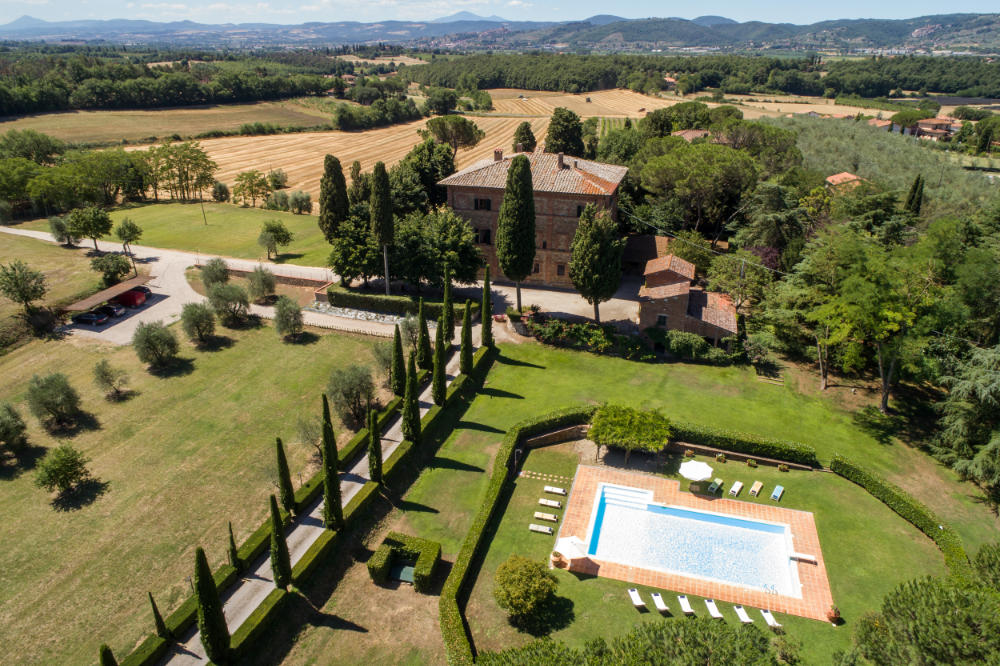
We have a beautiful villa close to Lucignano, just 3km away so even walkable if you wish. It sleeps 18 with a private pool and private grounds.
Author: Dan Wrightson
Dan Wrightson grew up in Tuscany, Italy and has been writing about, sketching and exploring Tuscany and Italy since 1983.
17th Jun 2026 23rd Jun 2026