Map of accessible museums in Florence
Wheelchair-friendly museums in Florence
Florence has more great museums per square kilometre than almost any city in Europe, which makes the access question especially pointed. While recent legislation has pushed museums in Italy to upgrade and invest in museum accessibility, historical buildings often present limitations, and some sites may have partial accessibility.
Cobblestones, steep streets up to Piazzale Michelangelo, and Renaissance staircases are not going away. What has changed is that the main civic and national collections have made a serious effort to fix what can be fixed: lifts, ramps, tactile routes, hearing loops and trained staff. Most of the big names are now genuinely accessible, and a few are genuinely exemplary. This list covers places that have made genuine provision, with honest notes on what you will actually encounter. I'm not a wheelchair user, so if you visit any of these venues and have notes for future visitors please contact me and I will gladly update and add to this page.
A practical note for Florence: visitors with a disability certificate (certificato di invalidità or Legge 104) can take a car into Florence's ZTL restricted zones. This removes one of the main logistical difficulties in reaching the central city museums - though parking can still be difficult.
Free access
Disabled visitors (and their helpers if listed) have a right to free access to national museums; privately managed venues may have different policies. Bring the certificate as you will need something to prove your disability. It used to be the EU disability card but since leaving the EU, British visitors will have to bring something similar instead.
Visitors report that usually a UK blue disability badge is accepted, while US visitors have also reported that, in general, original English language documents detailing disabilities will be accepted. I'm afraid I have no experience to offer here, so if anybody has better advice please write to me (via the contact form for the website) and I will correct, add and update this information.
Map of accessible museums in Florence with three-words links to help you navigate to all the museums. The map also shows the locations of our wheelchair accessible villas if you zoom out.
Galleria dell'Accademia
(Via Ricasoli 58) Fully accessible for standard wheelchairs and mobility aids. Book in advance to avoid queuing outside.
Uffizi Gallery
(Piazzale degli Uffizi) Thankfully this amazing museum is accessible: there is an access ramp from Via della Ninna. At the entrance door there are always receptionists available to help anyone in need. The Gallery is equipped with lifts at the beginning and at the end of the route, making the gallery entirely accessible.
Pitti Palace
(Piazza Pitti) This famous palace houses several museums, and they can all be reached via lifts in the right hand side of the courtyard. You will need to use a ramp to get into the courtyard, under the loggia. Once in the courtyard there are no steps and you will find a cafeteria, bookshop and accessible bathroom.
The Treasury of the Grand Dukes is accessed from the ground floor. The Palatine Gallery, the Gallery of Modern Art and the Museum of Costume and Fashion can be reached by lifts. Visitors with reduced mobility can also hire wheelchairs and walkers free of charge, with no reservation or deposit required.
If you want to visit the Boboli Gardens you will need somebody to accompany you. You can access the gardens on the left — past the statue of a fat naked man sitting on a turtle — or from Porta Romana, but the paths are steep and sometimes the clay mixes with the gravel and makes them difficult to navigate.
Museo dell'Opera del Duomo
(Piazza del Duomo) An amazing museum detailing and documenting the works connected to the creation of the Duomo in Florence, with works by Ghiberti, Michelangelo, Donatello and of course by Arnolfo di Cambio (who built the actual Cathedral but didn't know how to build such a large dome to cover it) and by Brunelleschi.
Ramps and lifts allow wheelchair users to explore the museum, and for the partially-sighted there is also what sounds like a fabulous project: Touchable, which allows certain visitors to explore a selection of the works by touch. More details here: Touchable Artworks
Museo del Bargello
(Via del Proconsolo) Housed in the oldest building in Florence, this is a museum rich in artworks from many of the great Renaissance artists. The palace itself was first public building in medieval Florence, the seat of the city magistrates or "Podestà". By the late sixteenth-century the building became the seat of the “Bargello”, i.e. the head of the city police, and was used as a prison for the following centuries
Most of the museum’s rooms are accessible, except for the Chapel and the Sacristy. Ramps are needed for certain sections, so staff will need to help - in busy times this can signal a non-optimal experience. Access to the Michelangelo Hall is through the bookshop, and the exit is through the same entrance. Adequate restroom facilities are available on the second floor.
Museo Galileo
(Piazza dei Giudici 1), on the Arno embankment, runs a programme called WELCOME specifically designed to improve access across all disability types, including sensory and cognitive. It is one of the more thoughtful approaches in the city.
Museo degli Innocenti
(Piazza della SS. Annunziata) Housed in the beautiful building designed by Brunelleschi as a hospital to care for abandoned babies, the museum was one of the first to adopt an inclusive approach. The museum has three routes exploring different aspects of the collection — the art, the architecture and the history.
Museo dell'Opificio delle Pietre Dure
(Via degli Alfani 78), dedicated to the extraordinary Florentine craft of inlaid stone, has lift access, but the lift is not suitable for heavy powered wheelchairs. Call before you go to confirm it is functioning — this is good practice in Italy generally.
Museo del Bigallo
(Piazza di San Giovanni 1), right beside the Duomo, has disabled access to a small but rewarding collection of early Florentine charitable art.
Museo Horne
(Via de Benci) An interesting collection of 14th to 16th century pieces assembled by an English scholar who wanted to create the feel of a 15th century Florentine dwelling. Includes beautiful pieces by Giotto, Simone Martini and more.
Palazzo Medici Riccardi
(Via de Ginori 2) The first palace of the Medici family, where Cosimo the Elder and Lorenzo the Magnificent lived, and artists such as Donatello, Michelangelo, Paolo Uccello, Benozzo Gozzoli, and Botticelli worked. Mostly accessible, entrance for wheelchair users from Via de Ginori 2.
Santa Maria Novella
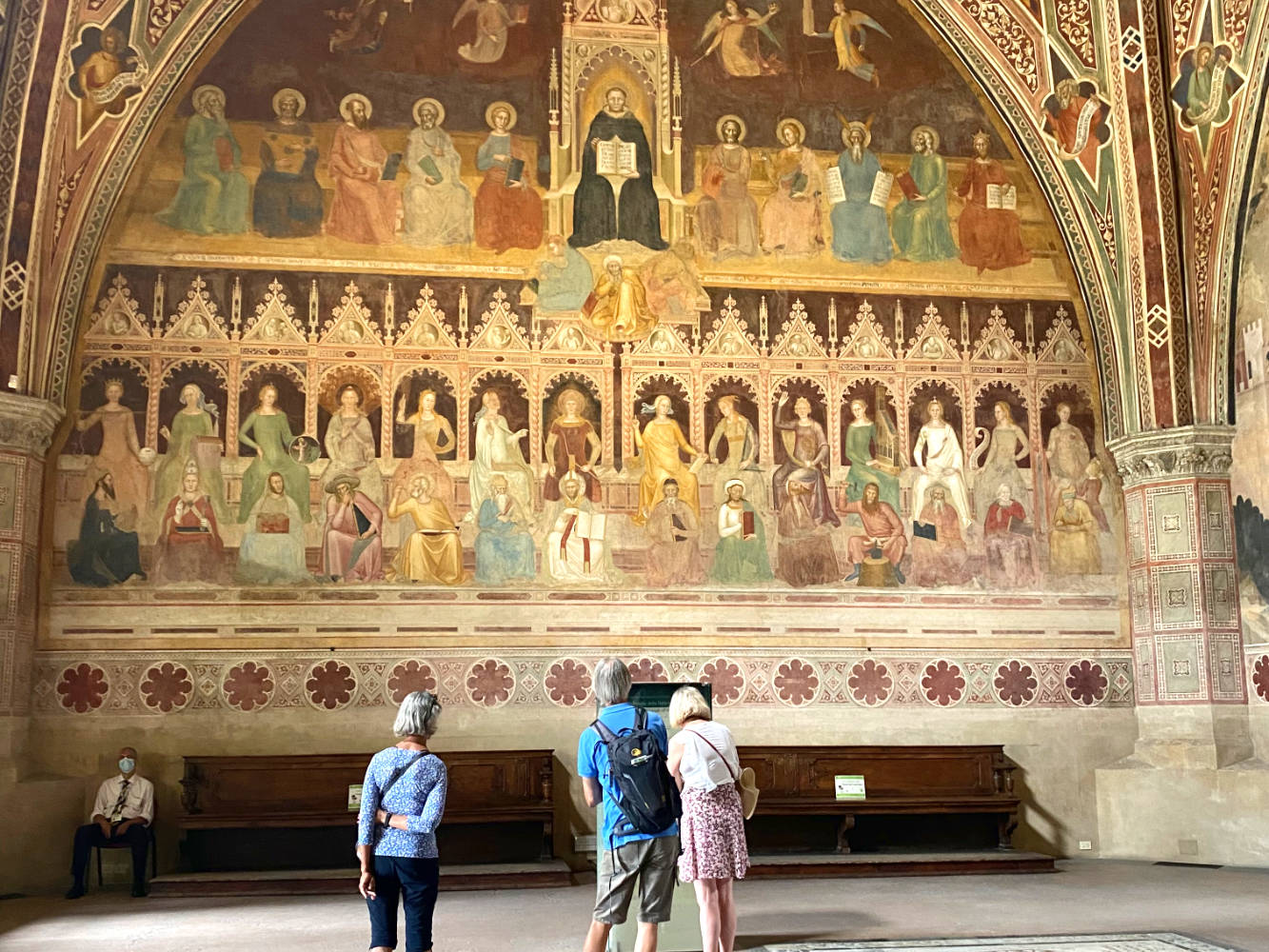
(Piazza Santa Maria Novella) The Monumental Complex of Santa Maria Novella is enormously important to renaissance history, art and architecture and there is an enormous amount to see here, from Alberti's facade to Masaccio's early forays into perspective and Giotto's very human, suffering crucifixion. Thankfully the museum is fully accessible.
One note: to go from the museum to the Basilica, take the emergency exit toward Piazza Santa Maria Novella and enter the church from the entrance in the Piazza. There is a bathroom in the museum equipped for people with mobility issues.
Brancacci Chapel
(Piazza del Carmine) The Church of Santa Maria del Carmine houses a small chapel, the 'Cappella Brancacci' home to a magnificent cycle of frescoes painted by Masolino, Masaccio and Filippino Lippi on three of the chapel's walls, at different times in history.
A route that runs through the cloister and the Chapter House allows wheelchair users to reach the chapel, with the use of an elevator. The other museum rooms are fully accessible. Accessible toilets are located on the ground floor of the cloister.
Useful resources
Turismo Senza Barriere offers guided accessible itineraries for Tuscany and other regions.
One consistent piece of advice: phone ahead. Lifts break, temporary exhibitions change floor layouts, and Italian museums do not always update their websites promptly. A two-minute call before travelling will save a wasted journey.
Author: Dan Wrightson
Dan Wrightson grew up in Tuscany, Italy and has been writing about, sketching and exploring Tuscany and Italy since 1983.
3rd Apr 2026 3rd Apr 2026